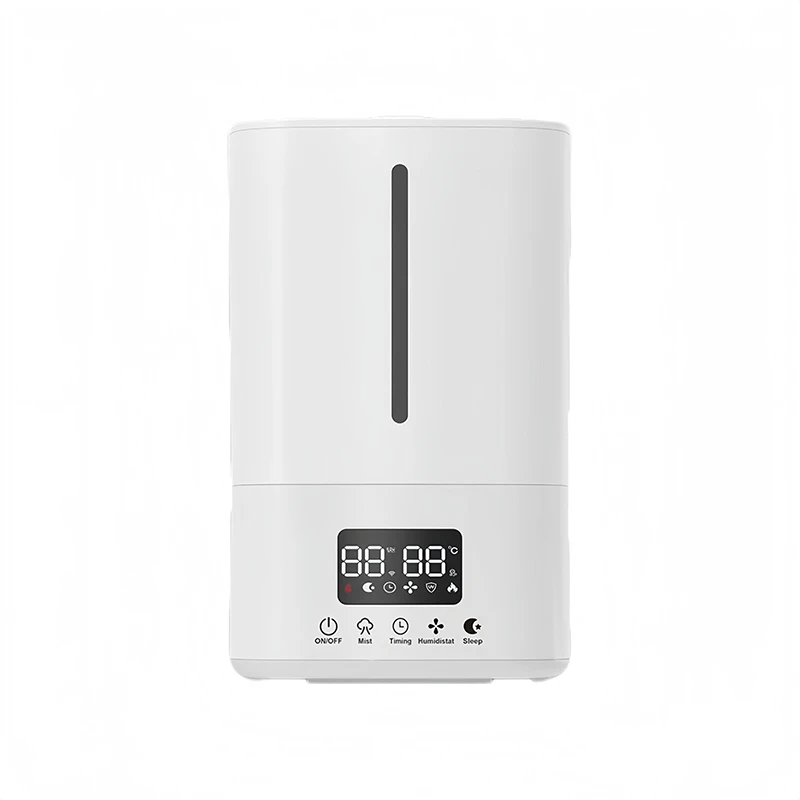

Based on their core humidification principles, humidifiers are primarily categorized into ultrasonic, evaporative (cold evaporation), and thermal evaporation types.
Ultrasonic humidifiers utilize an ultrasonic atomizing transducer to generate high-frequency oscillations (typically 2 million times per second), breaking water down into ultrafine particles with diameters ranging from 1 to 5 microns. A fan then blows this water mist outward, dispersing it into the air. Because this process produces visible mist, these devices are also referred to as "mist-generating humidifiers."
Evaporative humidifiers-also known as "pure-type" or "mist-free" humidifiers-employ a motor-driven fan to draw dry air through a moistened evaporation filter (or water curtain). Under the influence of the airflow, water molecules on the filter naturally evaporate, thereby achieving humidification. This process does not produce visible mist; furthermore, some models are capable of simultaneously filtering and purifying particulate matter from the air while humidifying.
Thermal evaporation humidifiers utilize an electric heating element to heat water to its boiling point, generating pure steam, which is then expelled by a motor. This represents a relatively simple method of humidification in terms of technology.
Additionally, there are other types of humidifiers, such as immersed-electrode humidifiers (which generate steam by heating water via electrodes submerged within it) and cool-mist humidifiers (which humidify by using a fan to force air through a water-absorbing medium).
Key performance parameters for humidifiers include humidification output, humidification efficiency, noise levels, water tank capacity, antibacterial technology, and smart features. Humidification output refers to the maximum humidifying capacity per unit of time, measured in milliliters per hour (mL/h); a higher value indicates stronger humidifying capability. Humidification efficiency refers to the amount of humidification produced per unit of power consumption, measured in milliliters per hour per watt (mL/h·W), and serves as a crucial metric for energy efficiency. Regarding noise levels, a range of 30 to 40 decibels is generally considered suitable for use in quiet environments. Water tank capacity determines the operating duration of the device on a single refill. To prevent bacterial growth within the water tank and internal water channels, common antibacterial technologies include UV sterilization and silver-ion filtration. Smart features-such as intelligent constant-humidity control-utilize built-in humidity sensors to automatically adjust the humidification output, thereby maintaining the indoor humidity level within a preset range (typically 40% to 65%).