

Two massage guns can look identical, quote the same RPM, and sit at the same price point - and one will still be working in year three while the other comes back as a return in month four. The difference usually sits in a component the buyer never sees: the motor and the electronics driving it.
Motor choice is one of the few decisions in a massage device that affects lifespan, noise, battery runtime and field failure rate at the same time. It is also one of the easiest things to get wrong when a quotation is compared line by line on price alone.
Ⅰ. The two motor types, without the marketing
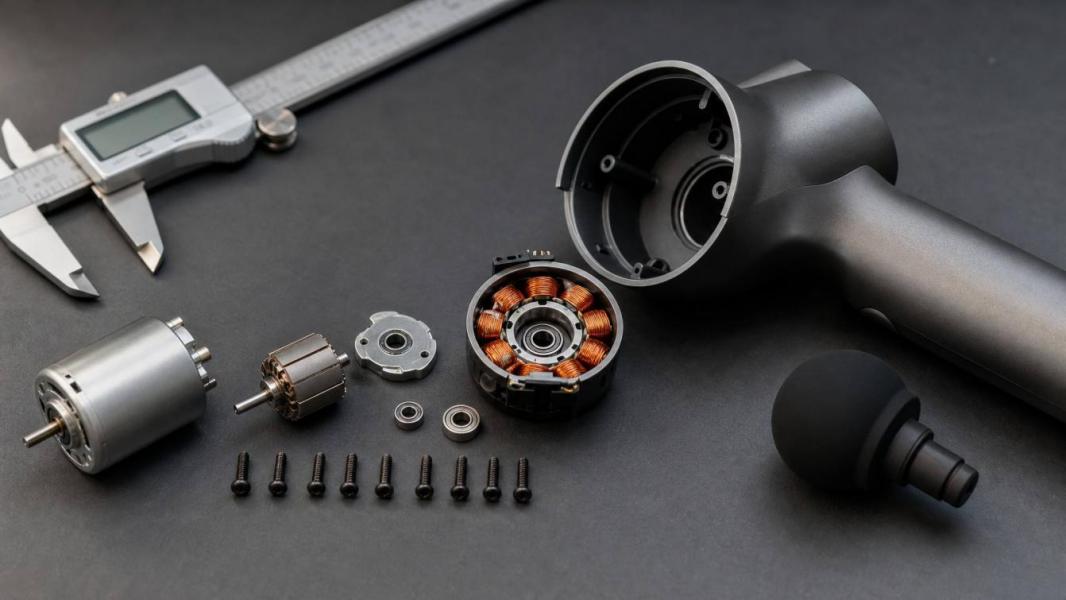
A brushed DC motor uses carbon brushes and a mechanical commutator to switch current through the windings. It is inexpensive, simple, and well understood. Its weak point is physical: the brushes wear down, carbon dust builds up inside the housing, and the commutator surface degrades over time.
A brushless DC motor (BLDC) replaces the mechanical commutation with electronics. There are no brushes to wear, so the wear-out mechanism moves from the motor to the bearings and the controller. The trade-off is cost and complexity: a BLDC needs a driver board with correct commutation logic, and a poorly tuned driver can fail faster than a good brushed motor.
Neither is automatically "better". The right answer depends on the product's price tier, duty cycle and the life the buyer is willing to warrant.
Ⅱ. Where brushed motors actually fail first
In handheld massage devices, brushed motor failures rarely come from the winding itself. They cluster around:
•Brush wear- the expected failure, and the main reason cheap guns lose power gradually before dying.
•Carbon dust- conductive debris inside the housing can cause intermittent faults or short the board.
•Commutator arcing- sparking at the brush interface creates electrical noise and accelerates wear, particularly at high RPM.
•Heat under load- a user pressing hard into a muscle raises current draw sharply; without thermal protection, the winding insulation degrades.
A brushed motor is not disqualified by these limits. It is disqualified when a supplier pairs it with no thermal cutoff, no stall protection and a duty cycle the user will obviously exceed.
Ⅲ. What brushless actually buys you - and what it doesn't
A properly implemented BLDC delivers three real advantages:
•Longer service life, because the dominant mechanical wear item has been removed.
•Lower electrical noise and generally quieter running, since there is no brush friction or arcing.
•Better efficiency at the same output, which translates into more usable runtime from the same battery.
What it does not automatically deliver is reliability. A BLDC is only as good as its driver: sensorless startup logic, over-current protection, stall detection and thermal management all sit on the control board. In field returns, a "brushless" gun with a weak controller can be less reliable than a well-built brushed one.
Ⅳ. Noise is a system property, not a motor spec
Buyers often assume a brushless motor makes a device quiet. In practice, at the ear the dominant noise sources are usually mechanical:
•Gear train- metal gears transmit high-frequency whine; POM or reinforced nylon gears run quieter at the cost of torque ceiling.
•Structure-borne vibration- the motor mount is the difference between a hum and a rattle; elastomer isolation between motor and housing matters more than the motor itself.
•Housing resonance- thin walls amplify vibration; ribbing and wall thickness change the sound character noticeably.
•Percussion mechanism- the piston and crank assembly in a reciprocating head contributes its own rhythmic noise.
•This is why a noise figure should always be quoted as a measured value at a stated distance (commonly dB(A) at 1 m) on a finished unit, not inferred from the motor type.
Ⅴ. Duty cycle and stall are where field failures are decided
Real users do not follow a spec sheet. They press the head hard against a tight calf muscle, run the device continuously for fifteen minutes, and recharge it whenever convenient. That behaviour defines the actual load case:
•Stall protection- when the head is pressed hard enough to stop rotation, current spikes. Without cutoff, the winding overheats within seconds.
•Thermal cutoff- a temperature sensor on the motor or board that reduces power or stops the device before insulation damage occurs.
•Duty cycle rating- the on/off ratio the device is designed for, stated honestly rather than implied by a marketing runtime figure.
•Battery protection- over-discharge protection in the BMS prevents the pack from being damaged by repeated deep discharge.
These four items cost very little to specify correctly and are the most common cause of "it died after a few months" complaints.
Ⅵ. What to ask before you approve the quotation
When comparing massage gun suppliers, request the following in writing:
•1. Motor type and manufacturer, plus the rated voltage and no-load speed.
•2. Rated torque or percussion force at the head, and the RPM at which it is measured.
•3. Which protections are present - stall, over-current, thermal, over-discharge - and whether they operate independently of the main controller.
•4. A measured noise figure on a finished unit at 1 m, at each speed level.
•5. The endurance test protocol: how many continuous operating hours, at what load and duty cycle, before the unit is considered passed.
•6. The claimed service life and the basis for that claim.
A supplier who can answer all six is describing a product. A supplier who answers only the first two is quoting a price.
Ⅶ. How we approach motor selection
At Junan Health Technology, motor and drivetrain selection is treated as a product decision rather than a cost line. Our engineering team matches brushed or brushless platforms to the target price tier and warranty position, specifies the protections above, and validates finished units with endurance and noise testing before mass production.
Our 4,000㎡ Dongguan facility holds ISO 9001 quality management and Class II medical device production qualifications, with automated SMT lines and in-house assembly for the control electronics that drive these motors.
Developing a massage gun or percussive device for your market? Tell us your target price tier, required service life and noise expectation, and we will recommend a motor and drivetrain configuration - and show you the test data behind it.


