

In a wearable massager, the material that touches skin is the product as far as the customer is concerned. It determines whether the device feels premium or cheap, whether it stays comfortable through a thirty-minute session, and - increasingly - whether it can legally be sold in the European Union and California at all.
Material selection is often treated as a cosmetic choice made at the sampling stage. In practice it is a compliance and returns decision, and it should be made deliberately.
Ⅰ. Why skin contact changes the requirement
A handle grip is touched for seconds. A heated knee wrap or wrist band sits against skin for twenty to thirty minutes, often while the user is warm and perspiring. That combination - warmth, moisture, friction and prolonged contact - is what drives the complaints buyers actually receive:
•Redness, itching or irritation after use.
•A chemical or plastic smell that does not fade.
•Discolouration or staining of the lining.
•Stiffening, cracking or peeling after a few months.
•Slipping, because the surface becomes slick once the user sweats.
•None of these show up in a one-minute sample review. They show up in reviews and returns.
Ⅱ. Silicone: the safest default, with cost and process caveats
Silicone is chemically inert, stable at body and device temperatures, and generally well tolerated in prolonged skin contact. It does not rely on plasticisers to stay soft, which removes an entire class of migration risk.
What buyers should check:
•Cure system.
•Platinum-cured (addition-cure) silicone is the grade normally specified for skin-contact and medical-adjacent products. Peroxide-cured silicone is cheaper but can leave residues and odour.
•Hardness.
Shore A hardness determines softness and grip; too soft deforms under a strap, too hard feels cheap against bone.
•Tear resistance.
Thin silicone sections can tear at strap anchors - a common warranty claim.
•Surface finish.
Matte finishes reduce slipping; high-gloss surfaces attract dust and show fingerprints.
The trade-offs are cost and processing: silicone is more expensive per kilogram and slower to mould than TPE.
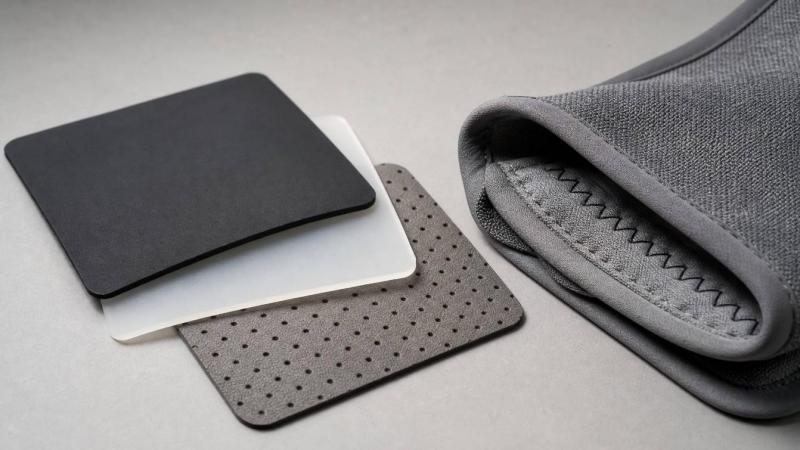
Ⅲ. TPE: soft, economical, and the material most likely to cause trouble
Thermoplastic elastomers are soft, easy to mould, and inexpensive. They are also the material where cheap formulations create the most avoidable problems.
•Plasticiser and oil migration.
TPE compounds frequently contain mineral oil or plasticiser to achieve softness. Under heat and pressure against skin, these can migrate, producing the tacky surface and the "chemical smell" that buyers complain about.
•Heat deformation.
Many TPE grades soften noticeably at the temperatures reached by a heated wearable, which is why TPE is a poor choice for the skin-side layer of a heated device.
•Staining and yellowing
over time, especially in light colours.
TPE can be a perfectly sound choice - for cool-touch grips, non-heated surfaces and cost-sensitive tiers - provided the compound is specified rather than left to the moulder's default.
Ⅳ. PU leather: premium appearance, poor breathability
Polyurethane-coated leather look-alike material is common on the outside of heated belts and knee wraps because it looks and photographs well. Its weaknesses are structural:
•Hydrolysis.
PU coatings degrade over time, particularly in warm, humid conditions, leading to peeling and flaking - the single most visible failure on a used device.
•No breathability.
A PU surface traps heat and moisture against the skin, which increases irritation risk during long sessions.
•Delamination at seams
where the coating separates from the backing fabric.
PU leather works best on short-contact, low-sweat applications or on outer surfaces where breathability is handled by a different layer.
Ⅴ. The regulatory layer buyers cannot skip
Material choice is also a market-access question. For sales into the EU and US, four regimes come up most often:
•REACH (EU).
Substances of Very High Concern on the candidate list carry information obligations above 0.1% by weight in an article. Annex XVII also restricts specific substances in articles, including certain phthalates in plasticised material, azo dyes in textiles and leather, and nickel release from metal parts in prolonged skin contact.
•RoHS (EU).
Applies to the electrical and electronic parts of the device rather than the soft materials, but is part of the same declaration package.
California Prop 65.
Requires a "clear and reasonable warning" for listed chemicals present above the applicable threshold - several phthalates and lead are on that list. Many brands choose reformulation over labelling.
•EU General Product Safety Regulation.
Places the burden of demonstrating safety on the seller, which in practice means documented material specifications rather than verbal assurances.
Where a device is positioned as a medical device, biocompatibility testing to ISO 10993 for skin irritation and sensitisation typically becomes part of the file as well.
Ⅵ. The test reports that should travel with your materials
Ask for these before approving a sample, and make sure they reference the specific material grade - not a generic family name:
1. SVHC screening against the current REACH candidate list.
2. A phthalate panel covering the restricted phthalates, reported per substance rather than as a pass/fail.
3. Azo dye testing for textile and leather components.
4. Nickel release testing for any metal part in prolonged skin contact.
5. Odour and colour-fastness results after a defined heat and humidity exposure.
6. For medical positioning, ISO 10993 skin irritation and sensitisation data.
A report that names a different grade from the one in your bill of materials is worth nothing at customs or in a recall.
Ⅶ. A specification checklist
Before mass production, confirm in writing:
•Material grade and supplier for every skin-contact surface, stated by trade name and hardness.
•Cure system for silicone; plasticiser type and content for TPE.
•Whether the material is rated for continuous contact at the device's maximum operating temperature.
•Breathability and wicking construction for heated wearables.
•The full test report package, matched to the grades in the BOM.
•The cleaning method the material tolerates, and how the user manual states it.
Ⅷ. How we handle material selection
At Junan Health Technology, skin-contact material selection is part of product development rather than a purchasing afterthought. We specify grades for silicone, TPE and textile components, validate them against the device's operating temperature, and assemble the material test documentation that EU and US buyers ask for - alongside CE, RoHS and FCC compliance for the electronics.
Our 4,000㎡ Dongguan facility holds ISO 9001 quality management and Class II medical device production qualifications, with a controlled assembly environment for wearable therapy products.
Choosing materials for a wearable massager? Send us your target market, contact duration and temperature profile, and our engineering team will recommend a material stack with the documentation your market requires.


